

That’s the noise right now and it’s a lot. Not because we can’t keep up or because we are doing something wrong.
But because suddenly there’s a new tool, new rules and a thousand opinions on how you’re “supposed” to use it.
So let’s do something simple. I want to show you how to use AI for your job search in a way that actually helps.
First truth: using AI is not cheating and you should be using it
If you’re job searching, you’ve probably already used ChatGPT for things like:
“Can you make this CV bullet match the job title?”, “Help me write a follow-up to a recruiter”, “Is this salary range realistic?”, “Can you make this cover letter sound more natural?’ and the list goes on.
That’s normal and honestly, it makes sense. The problem isn’t using AI.
The problem is copying what it gives you and sending it without questioning it.
Because from the hiring side, those answers start to blend together fast.
They’re polished. They’re confident. And identical to dozens of other applications.
AI works best when it helps you think more clearly and speak more directly.
Not when it smooths out your experience until it could belong to anyone.
✦ ✧ ✦
Second truth: hiring teams can usually tell when AI is doing the talking
Not because they’re anti-AI. Most of them use it too.
It’s because the same phrases keep showing up everywhere.
The same “I am excited to leverage my transferable skills” energy.

And when everything sounds the same, nothing stands out.
The good news is this is easy to fix. You don’t need to stop using AI, you just need to make it your assistant, not your voice.
✦ ✧ ✦
So here’s what to do instead
Stop asking AI to write for you. Start using it to think with you.
A simple rule I use every time is this: clarify, then refine.
First, tell AI what you’re trying to say in your own words, even if it’s messy.
Then ask it to help you tighten it, shorten it or make it clearer.
Before you send anything, pause and ask one question:
“Could I say this out loud without cringing?” If not, rewrite it.
✦ ✧ ✦
Here’s exactly how to use it
✨For your CV
Instead of asking: “Write my CV”
Try this:
“Here’s my experience and the job description. Help me figure out which parts matter most for this role and how to phrase them clearly.”
Then read it back and ask one more thing: “What sounds vague here?”.
Most people skip this step. It’s also where the difference is made.
✨For your cover letter
Instead of asking:“Write my cover letter”
Try this:
“Here’s my experience and the role I’m applying for. Help me figure out which parts matter most for this job and how to explain them clearly.”
Read it out loud. If it sounds robotic or like something you’d never say in a real conversation, adjust it.
AI can help with structure, but you give the tone.
✨For follow-ups and messages
Instead of asking AI to write the whole thing, try:
“Here’s what I want to say. Help me make it sound clear and confident, not awkward.”
That keeps the message human and it keeps you in control.
✦ ✧ ✦
How to get better answers from ChatGPT (this matters more than you think)
One thing that changed everything for me is how I talk to it.
If I just paste something in and say “make this better” the output is fine. But when I slow down and guide it a bit, the difference is huge.
Here are prompts I actually use and recommend:
Before answering, ultra-think. Ask me 1-2 clarifying questions if needed
What could go wrong if I send this as is? List the top 3 risks
Does this sound like a real person or AI? (Yes, I know. Asking AI if it sounds like AI!?!?)
Make this clearer, not longer. Keep the meaning, cut the extra
Rewrite this in a confident, natural tone. No overly polished phrases
If anything sounds like “any candidate could say this” flag it and rewrite it
Sometimes I’ll even say:
Search the web and base this on real examples, not generic advice.
That one alone changes the quality a lot. You’re basically telling ChatGPT how to think, not just what to write.
And once you do that, the answers stop sounding generic and start sounding useful.
✦ ✧ ✦
Big Sister note
I chose to write about this because you asked about using AI and I could feel the hesitation behind the questions.
Not fear exactly. More like, “Am I doing this right?”. So here’s what I want you to hear clearly.
You’re not cutting corners for using AI. You’re not less capable for wanting help thinking things through. And you don’t need to prove anything before you’re “allowed” to use the tools available to you. BUT please don’t fall into the trap.
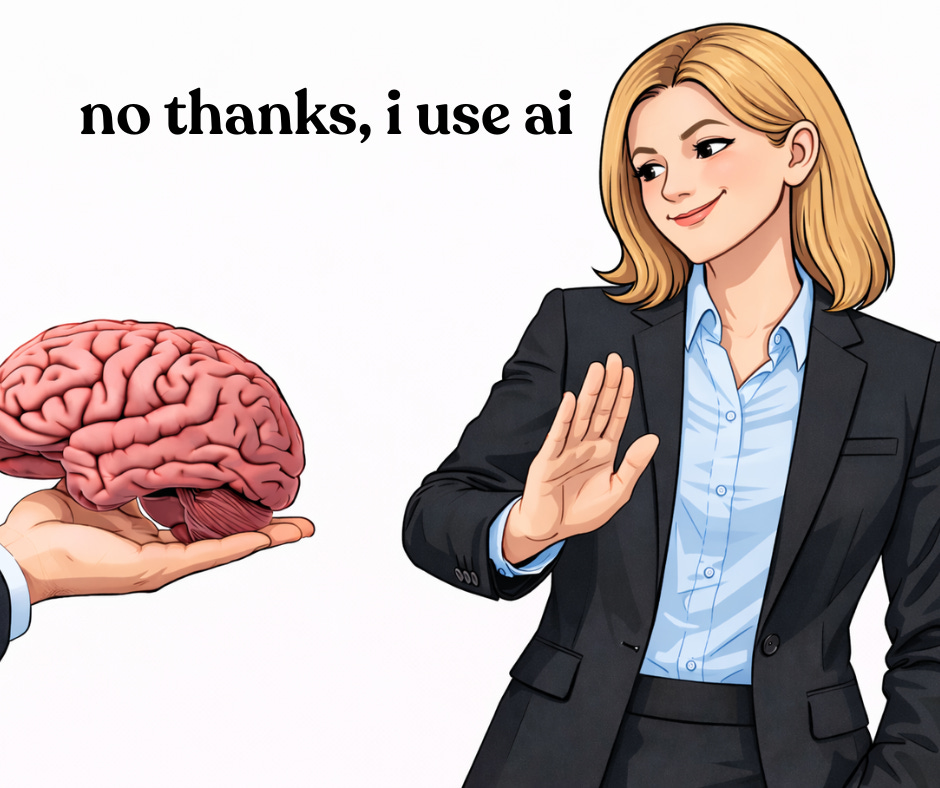
Used well, AI doesn’t replace your judgment. It sharpens it.
You already bring the experience, the instincts and the context.
You don’t need to master this perfectly. You just need to use it intentionally. 💅🏼
And if you’re reading this and thinking, “I wish you talked about X next” reply and tell me what X is. That’s genuinely how I decide what to write about.
You can reply directly to this email or message me on Substack. I read every one. ✨